How to Get a Coachella Valley Mortgage When Your Earnest Money Deposit Comes From Multiple Accounts (Without Underwriting Delays)
Buying in the Coachella Valley? Learn how to document an earnest money deposit from multiple accounts to avoid underwriting delays. MortgageWorks can help.
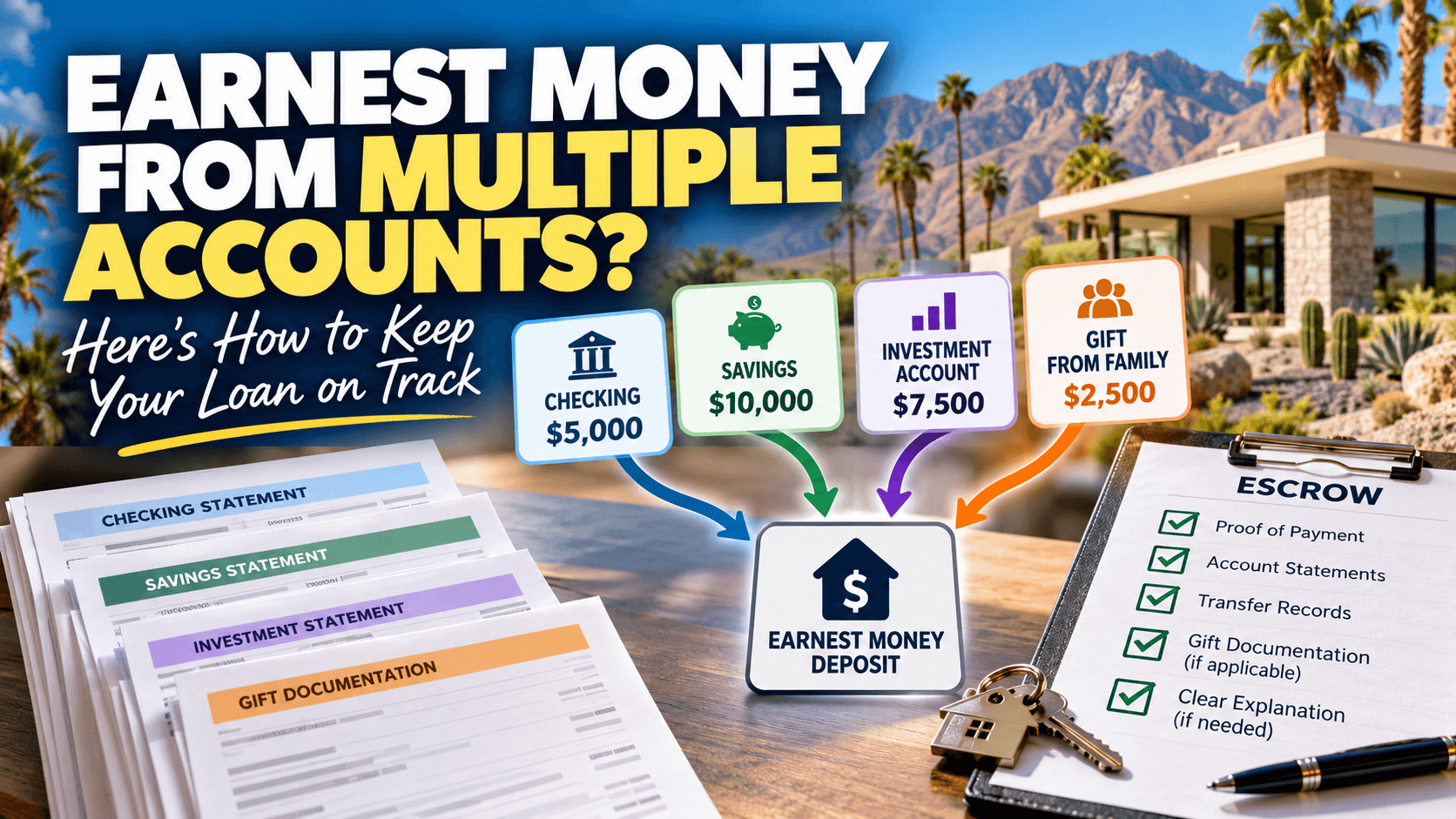
You’re under contract on a home in the Coachella Valley, the clock is ticking, and your earnest money deposit (EMD) is due. You move money the way most people do in real life: a little from checking, some from savings, maybe a transfer from a high-yield account, and possibly a gift from a family member to round it out. The deposit clears, escrow is happy—and then underwriting asks the question that can slow everything down: “Please document the source of funds for the earnest money deposit.”
This is a common mortgage friction point because the EMD is one of the first real money movements tied to the purchase, and it often comes from multiple places. The good news: it’s fixable, and it’s usually fixable quickly—if you document it the right way and avoid a few common mistakes.
Below is a practical, step-by-step approach MortgageWorks uses to help buyers in Palm Desert, Palm Springs, Rancho Mirage, La Quinta, Indian Wells, Indio, Cathedral City, Desert Hot Springs, and throughout our licensed service areas keep underwriting moving when the EMD comes from multiple accounts.
1) The problem: earnest money from multiple accounts triggers sourcing questions
Underwriters don’t just want to see that you had enough money overall. They want to see a clear paper trail showing where the specific funds used for the EMD came from.
When the deposit is built from multiple accounts, the “paper trail” often gets messy for three reasons:
- The EMD check or wire comes from Account A, but the money originated in Accounts B and C.
- Transfers happen close to the deposit date, creating what looks like “new money” or “large deposits.”
- Screenshots, partial statements, or missing pages make it impossible to match transfers to balances.
The result is typically an underwriting condition asking for additional statements, transfer confirmations, or explanations. That condition can be minor—or it can turn into a chain reaction if the documentation is incomplete.
2) Why underwriters care (and what they’re actually verifying)
Most buyers assume this is about judging their spending. It’s not. Underwriters are generally verifying three things:
A) Ability to close
They need to confirm you have sufficient verified funds for the down payment, closing costs, and reserves (if required), not just for the EMD.
B) Acceptable source of funds
Funds must come from acceptable sources under the loan program rules. Typical acceptable sources include your own verified assets, properly documented gifts, proceeds from the sale of an asset (like stocks), retirement distributions/loans (if allowed), or sale of a home.
C) No undisclosed debt
If money appears suddenly, underwriting wants to ensure it wasn’t borrowed (for example, a personal loan, cash advance, or new credit line) that would change your debt-to-income ratio.
In short: underwriting is trying to confirm the money is yours (or an eligible gift), it’s documented, and it doesn’t create new debt.
3) The step-by-step fix: how to document each transfer cleanly
If your earnest money came from multiple accounts, the cleanest solution is to build a simple “source of EMD” package. Here’s how.
Step 1: Identify the exact EMD amount and how it was delivered
- Was it a wire from your bank to escrow?
- A cashier’s check?
- A personal check?
Get the proof of payment:
- For a wire: wire confirmation/receipt showing sender account, recipient (escrow), date, and amount.
- For a cashier’s check: a copy of the cashier’s check and the bank receipt showing the withdrawal account.
- For a personal check: a copy of the check plus evidence it cleared (transaction history or statement showing it posted).
Step 2: Choose the “final account” the EMD came from
This is the account that actually sent the wire or funded the check. Underwriting will start here.
Provide:
- The most recent statement(s) required by your lender for that account (often the last 1–2 months, but follow your loan team’s request).
- All pages of the statement, even if some pages are blank or “intentionally left blank.” Missing pages are a common reason conditions get re-issued.
Step 3: Trace each incoming transfer into the final account
For each transfer that helped build the EMD balance, provide documentation from both sides:
- The statement from the “from” account showing the money leaving.
- The statement from the “to” account showing the money arriving.
If the transfer happened between statement cycles (so it doesn’t appear on the statement yet), provide a transaction history printout that includes:
- Your name
- Bank name
- Account number (masked is fine)
- Date, amount, and description
Step 4: If any part was a gift, document it correctly
Gifts are allowed on many loan types, but they must be documented. Typically this includes:
- A gift letter (lender form)
- Proof the donor had the ability to give (donor statement)
- Proof of transfer (donor-to-borrower transfer and deposit)
Important: if the donor gives you cash, or you deposit cash, that often creates a documentation problem. It may still be workable in some cases, but it’s the slowest path. If a gift is planned, it’s usually best to transfer electronically with a clean trail.
Step 5: Avoid “helpful” shortcuts that create new questions
These are the most common delay triggers:
- Submitting screenshots instead of full statements
- Sending only the first page of a statement
- Highlighting items but not providing the underlying statement pages
- Moving money through multiple apps/accounts (for example: savings → app → checking → escrow) without keeping records
If you already did this, don’t panic—just be ready to provide more documentation so the trail is complete.
Step 6: Write a brief, factual explanation when needed
Sometimes the documentation is solid but the story isn’t obvious. A short letter of explanation can help, especially when multiple transfers are involved.
Keep it simple:
- “On [date], I transferred $X from my [bank] savings to my [bank] checking to fund the earnest money deposit for [property address].”
- “On [date], I received a gift of $X from [donor name/relationship] which was used toward the earnest money deposit.”
No long narratives—just dates, amounts, and purpose.
4) Common Coachella Valley scenarios that create EMD sourcing issues (and how to handle them)
Because many buyers in the Coachella Valley are relocating, buying a second home, or managing multiple financial institutions, these scenarios come up often.
Scenario A: You keep most funds in a high-yield savings account, but EMD came from checking
Solution: Provide statements for both accounts and the transfer record. If the high-yield account is at a different bank, make sure the statement clearly shows your name and account number (masked is fine).
Scenario B: You moved money from an investment account to cover the deposit
Solution: Provide the brokerage statement showing the sale/withdrawal and the transfer into your bank account. If the funds were liquidated (sold), include the trade confirmation if requested.
Scenario C: You used multiple smaller transfers to avoid moving a large lump sum
Solution: Underwriting may still want to see each transfer. It’s not “bad,” it’s just more items to document. Provide a clean set of statements and, if helpful, a simple list of transfers (date/amount/from/to) so the reviewer can match them quickly.
Scenario D: A family member reimbursed you after you already sent the EMD
Solution: This can be tricky depending on timing and the loan program. Underwriting may treat the reimbursement as a gift or as new funds that must be sourced. If you anticipate this situation, talk to your loan team before moving money so it’s structured and documented correctly.
Scenario E: You’re buying a condo and the timeline is tight
Condos in Palm Springs, Palm Desert, Rancho Mirage, La Quinta, and Indian Wells can involve additional HOA-related review items, which means you don’t want avoidable asset conditions slowing the file.
Solution: Treat EMD sourcing as a “front-loaded” task—get the statements and transfer proof to your lender as soon as escrow opens.
5) A pre-offer checklist to prevent last-minute conditions
If you haven’t sent the EMD yet—or you’re planning to buy soon—this checklist can prevent the entire issue.
- Decide which single account will fund the EMD (the “final account”).
- Move funds into that account early enough that they appear on a statement or are easily supported by transaction history.
- Avoid cash deposits.
- If a gift is involved, use an electronic transfer and keep the donor documentation ready.
- Keep PDF statements downloaded (not screenshots) for every account involved.
- Tell your loan officer in advance: “My EMD will come from multiple accounts,” so they can tell you exactly what to save.
When this is handled proactively, underwriting conditions are usually straightforward and quick to clear.
How MortgageWorks helps
MortgageWorks helps buyers across the Coachella Valley build a clean, underwriter-friendly documentation trail—before it becomes a closing-week emergency. If your earnest money deposit is coming from multiple accounts (or already has), we can tell you exactly what to provide, how to label it, and how to avoid common sourcing pitfalls so your loan stays on schedule.
If you’re buying in Palm Springs, Palm Desert, Rancho Mirage, La Quinta, Indian Wells, Indio, Cathedral City, Desert Hot Springs, or anywhere else we’re licensed to lend, we’ll tailor the documentation plan to your exact accounts and timeline.