How to Explain Large Deposits on Bank Statements for a Coachella Valley Mortgage (Without Underwriting Delays)
Buying in the Coachella Valley? Learn how to document large bank deposits for a mortgage so underwriting doesn’t stall in Palm Desert to Palm Springs.
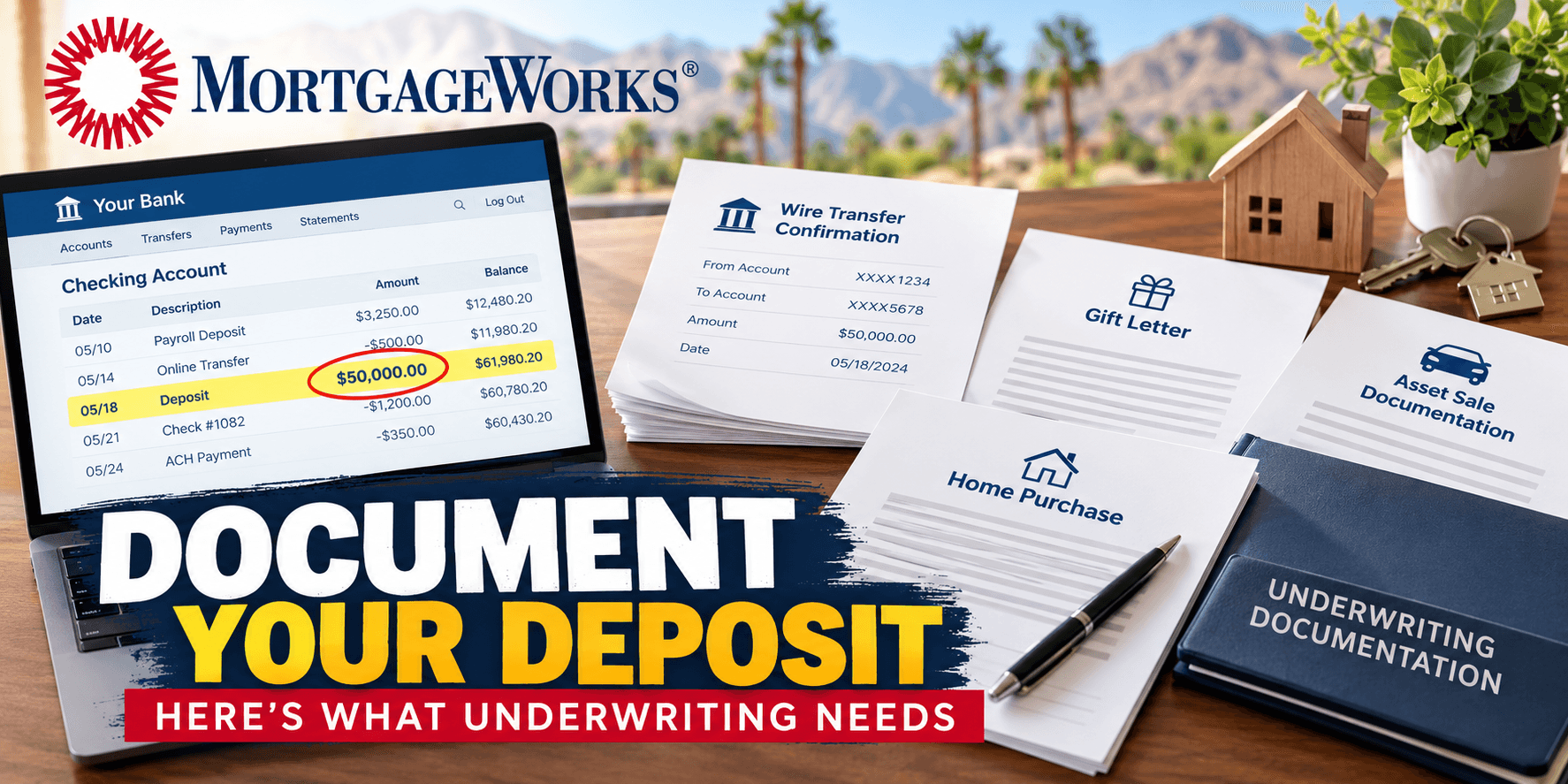
If you’ve been house hunting in the Coachella Valley—Palm Desert, Palm Springs, Rancho Mirage, La Quinta, Indian Wells, Indio, Cathedral City, or Desert Hot Springs—you’ve probably heard some version of this from a lender: “Underwriting needs an explanation for that deposit.”
It can feel frustrating because the money is yours, it’s sitting in your account, and you’re ready to move forward. But from an underwriting standpoint, a “large deposit” isn’t a judgment—it’s a compliance checkpoint. If it isn’t handled cleanly, it can trigger extra conditions, slow your approval, and in the worst cases force last-minute changes to your down payment plan.
Below is a practical, problem/solution guide to explaining large deposits for a mortgage so your MortgageWorks file can move through underwriting with fewer back-and-forth requests.
1) The problem: why “large deposits” create underwriting delays
Mortgage underwriting is built around verifying two things about your funds:
A) Ability to repay (income and debts)
B) Acceptable source of funds (down payment, closing costs, and reserves)
When your bank statements show a deposit that’s bigger than your typical pattern, the underwriter has to confirm it came from an acceptable source and isn’t an undisclosed loan.
Why this matters in real life: If you’re in escrow with tight timelines—common in competitive pockets of Palm Springs and Palm Desert—every extra condition can add days. And because conditions often stack (one document leads to another), a single unexplained deposit can snowball into multiple requests.
2) What underwriting is really verifying (and what counts as “large”)
Underwriters don’t just want a note that says, “This was a gift” or “This was savings.” They want a paper trail.
What counts as a large deposit varies by loan type and lender overlays, but a common rule of thumb is any single deposit that’s more than a certain percentage of your monthly qualifying income, or any deposit that’s inconsistent with your normal deposit pattern.
Underwriting is trying to answer:
- Where did the money come from?
- Can we document it with third-party records?
- Does it create new debt (like a personal loan) that should be counted?
- Does it violate any program rules (for example, undocumented cash deposits)?
In other words, the “explanation” is not just a letter—it’s documentation that supports the story.
3) The solution: document the deposit by source (with the right paperwork)
The fastest way to clear a large deposit condition is to identify the source category and provide the matching documents up front. Here are the most common acceptable sources and what typically satisfies underwriting.
A) Payroll or regular income that posted differently
Sometimes a bonus, commission, or payroll change hits your account and looks unusual.
What to provide:
- Pay stub(s) showing the bonus/commission
- If needed, an employer letter confirming the payment type and date
- Bank statement showing the deposit
Tip: If the deposit description in your bank statement clearly matches your employer/payroll provider, it can reduce questions.
B) Transfer from another account you own (checking, savings, brokerage)
This is one of the easiest to document, but it often gets delayed because borrowers only send one side of the transfer.
What to provide:
- Statement from the “from” account showing the money leaving
- Statement from the “to” account showing the money arriving
- If it’s a brokerage: transaction history showing liquidation and transfer
Tip: If you moved money between institutions, include the page that shows your name and account number (even if partially masked) so it’s clearly your account.
C) Sale of an asset (vehicle, boat, equipment, collectibles)
Asset sales are acceptable when documented properly. The key is proving ownership, sale, and deposit.
What to provide:
- Bill of sale (signed, dated, identifying the asset)
- Proof you owned it (title/registration where applicable)
- Copy of the buyer’s check or proof of funds transfer
- Bank statement showing the deposit
Tip: Cash sales are where deals get messy. If you can, avoid cash and use a traceable method (cashier’s check, wire, or electronic transfer).
D) Gift funds from family
Gift funds are common for Coachella Valley purchases, especially when buyers are trying to bridge the gap between down payment and closing costs.
What to provide (typical requirements):
- Gift letter (lender-provided form)
- Donor’s bank statement showing ability to give the gift
- Proof of transfer (wire receipt, cashier’s check copy, or electronic transfer record)
- Your bank statement showing receipt
Important: The donor’s funds must be sourced too. If the donor has a large deposit right before gifting you, underwriting may ask where the donor’s deposit came from.
E) Retirement account distribution (401(k), IRA)
Many buyers relocating or buying a second home in the desert use retirement distributions.
What to provide:
- Distribution statement from the retirement account
- Proof of deposit into your bank account
- If applicable, evidence of taxes/withholding (not always required, but helpful)
Tip: If you’re borrowing from a 401(k) (a loan, not a distribution), that can create a payment that must be counted in your debt ratios. Tell MortgageWorks before you do it.
F) Business funds (self-employed or business owner)
If you’re moving money from a business account to personal, underwriting will usually require extra documentation to confirm it won’t harm the business.
What to provide (varies by program):
- Business bank statements (and sometimes multiple months)
- A letter from you/CPA explaining the transfer
- Evidence the business has sufficient liquidity after the transfer
Tip: Don’t assume “it’s my company” ends the conversation. Underwriting still needs to document it.
G) Proceeds from a home sale or refinance
If you sold a property (or recently refinanced and pulled cash out), this is generally straightforward.
What to provide:
- Closing Disclosure (CD) or settlement statement from the sale/refi
- Proof of wire or check
- Bank statement showing deposit
4) Common Coachella Valley scenarios that trigger large-deposit questions
Because the Coachella Valley has a mix of primary residences, second homes, retirees, and self-employed buyers, a few patterns show up often.
Scenario 1: You’re consolidating accounts before buying
Buyers often move funds from multiple banks into one “purchase account” to simplify. Ironically, that can create multiple large deposits.
Best practice: Provide the statements for every account involved and label each transfer clearly (date, amount, from/to).
Scenario 2: You deposited cash from “saving over time”
Cash deposits are one of the hardest items to document because there’s no third-party paper trail.
What to know: Many loan programs will not allow undocumented cash deposits to be used toward required funds to close. Even if the cash is legitimate, the inability to document the source can cause delays or require you to exclude those funds.
Best practice: If you have cash, talk to MortgageWorks before depositing it. There may be a better approach depending on your overall assets and timeline.
Scenario 3: You received money from a friend (not a documented gift)
If someone “paid you back” or “loaned you money,” underwriting may treat it as borrowed funds unless it’s clearly documented as a gift (and allowed).
Best practice: Avoid informal transfers during escrow. If funds are needed, structure them correctly as a gift (if eligible) with the proper documentation.
Scenario 4: You’re self-employed, and your deposits don’t look like payroll
Business owners often have irregular deposits that can look like “large deposits” even when they’re normal revenue.
Best practice: Keep business and personal accounts cleanly separated where possible, and be ready to document transfers and business statements.
Scenario 5: You sold investments to fund the purchase
Liquidating stocks or mutual funds is common, especially for buyers purchasing in Indian Wells, Rancho Mirage, or La Quinta.
Best practice: Provide the brokerage statement showing the sale and the transfer into your bank account. A screenshot usually isn’t enough; underwriting typically wants official statements or transaction histories.
5) How to avoid rework: timing and what not to do before closing
A few moves can create avoidable underwriting conditions:
- Don’t open new credit or take out new loans to “temporarily” cover closing costs.
- Don’t move money repeatedly between accounts without keeping statements for each step.
- Don’t deposit large amounts of cash during escrow without talking to your lender first.
- Don’t assume a written explanation alone will clear the condition—pair it with third-party documentation.
Also, timing matters. Underwriting typically reviews the most recent statements. If a large deposit appears on the newest statement and you can’t document it quickly, you may lose time waiting for additional statements or alternative verification.
6) A simple checklist to send MortgageWorks (so your file keeps moving)
If you know you have a large deposit (or you’re planning one), gather this package early:
- The bank statement page showing the deposit (with date and amount)
- A short letter of explanation that states:
- What the deposit is
- Where it came from
- Whether it must be used for closing (or is just sitting in the account)
- Third-party documents that prove the source, based on category:
- Pay stub/bonus statement, or
- Transfer statements from both accounts, or
- Gift letter + donor statement + proof of transfer, or
- Asset sale paperwork + proof of payment, or
- Retirement distribution statement + proof of deposit, or
- Closing Disclosure from sale/refi + proof of deposit
If you’re unsure which category fits, the best move is to ask before you send partial documents. A clean, complete submission is usually faster than multiple rounds of “one more thing.”
In the Coachella Valley market, speed and certainty matter. When your funds are documented correctly, underwriting can focus on the rest of the file—and you’re less likely to face last-minute conditions that threaten your closing date.
MortgageWorks helps buyers across Palm Desert, Palm Springs, Rancho Mirage, La Quinta, Indian Wells, Indio, Cathedral City, Desert Hot Springs, and all other licensed areas we serve. If you want, we can review your bank statements and tell you exactly what documentation will satisfy underwriting before it becomes a problem.